

Commercial Solar Panel Cost UK
How Much Does a Commercial Solar System Cost in 2026?
For many UK businesses, commercial solar is no longer simply an environmental investment. Falling equipment costs and high commercial electricity prices have made solar an increasingly practical way to reduce long-term operating costs.
So, how much does a commercial solar system cost?
As a broad 2026 guide, fully installed commercial solar systems typically cost around £700 to £1,100 per kWp, although smaller or more complicated installations can exceed this range. Another current UK commercial installer quotes a wider market range of approximately £660 to £1,200 per kWp.
The overall commercial solar panel installation cost depends on considerably more than the number of panels. Roof construction, access, electrical infrastructure, inverter

overnment statistics also track the installed cost of UK solar PV on a per-kW basis and confirm the continuing importance of system capacity when comparing installations.
Average Commercial Solar Panel Cost
Commercial solar is usually priced according to the total generating capacity of the installation, expressed in kilowatt peak — kWp.
Indicative 2026 costs are:
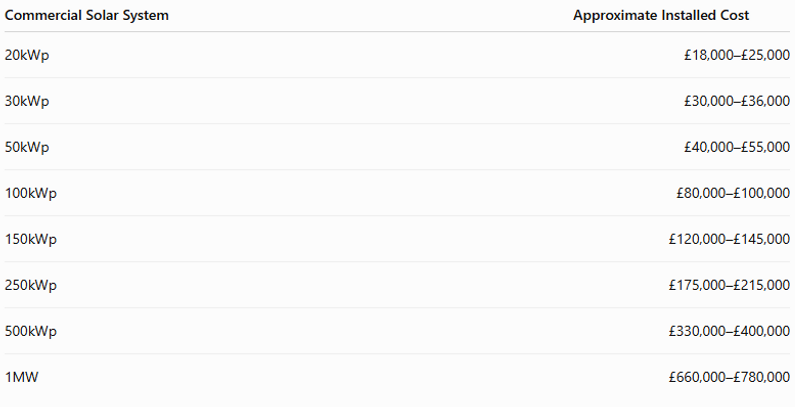
These figures are intended as budgeting guides rather than quotations. Current UK commercial installers report approximately £700–£1,100 per kWp, with unit costs generally falling as installations become larger.
Prices for commercial installations are normally quoted excluding VAT, so businesses should check the VAT treatment of any quotation and whether VAT can be recovered.
Commercial Solar System Cost Per kWp
The useful figure when comparing quotations is usually not the price per panel but the fully installed price per kWp.
A typical range might look like:
Smaller commercial systems:
around £1,000–£1,200 per kWp
Medium commercial installations:
around £800–£1,000 per kWp
Large industrial solar installations:
around £660–£850 per kWp
The reason is straightforward. A commercial installation has fixed costs for design, surveying, electrical work, project management, access and grid connection.
Those costs can be distributed across hundreds or thousands of panels on a large industrial roof, producing significant economies of scale. Current UK market guides show a 30kWp installation around £1,000–£1,200/kWp compared with approximately £660–£800/kWp for a 500kWp installation.
This is why simply asking “How much does one commercial solar panel cost?” can be misleading.
The important figure is the total installed system cost.
Commercial Solar Panel Installation Cost
The commercial solar panel installation cost is made up of several elements.
Solar panels
The modules themselves represent an important part of the cost, but commercial projects can obtain substantially better unit pricing than small domestic installations because panels are purchased in greater quantities.
Inverters
Solar panels generate DC electricity.
Commercial inverters convert this into AC electricity that can be used within the building or exported to the electricity network.
Large installations may use several string inverters rather than one single unit, providing flexibility and potentially improving system resilience.
Mounting system
Mounting costs depend heavily on the building.
Commercial solar may be installed on:
-
flat roofs
-
pitched roofs
-
metal profile roofs
-
standing-seam roofs
-
industrial sheds
-
warehouses
-
agricultural buildings
-
ground-mounted frames
-
solar carports.
A straightforward modern warehouse roof may therefore cost considerably less to equip than an older building requiring specialist access or structural strengthening.
Scaffolding and access
Roof access can become a significant element of commercial solar costs.
Cherry pickers, scaffolding, edge protection, lifting equipment and temporary access systems may all be required.
Large buildings with easy roof access may therefore achieve a lower installation cost per kWp.
Electrical installation
Commercial solar projects normally require more extensive electrical infrastructure than domestic installations.
This can include:
-
AC and DC isolators
-
distribution equipment
-
generation meters
-
switchgear
-
cabling
-
monitoring equipment
-
protection systems
-
three-phase connections
-
amendments to existing distribution boards.
Design, surveys and commissioning
Commercial solar should normally be preceded by an assessment of the building, electricity consumption and roof structure.
Grid connection requirements also need to be established before the final system specification is confirmed.
Solar Panels for Commercial Buildings Cost
The cost of solar panels for commercial buildings depends largely upon the size and type of property.
A smaller office building may only require a 20–30kWp array.
A substantial warehouse could accommodate several hundred kilowatts.
A large distribution centre, factory or logistics building may potentially accommodate an installation measured in megawatts.
The UK Government specifically identifies commercial buildings as having significant solar potential because of their large available roof areas. Planning changes have also removed the previous 1MW permitted-development cap for many non-domestic rooftop installations in England, making larger commercial rooftop projects easier to pursue.
As a rough example:
Small commercial building – 30kWp
Approximately £30,000–£36,000
Suitable for smaller offices, workshops, retail premises and similar buildings.
Medium commercial building – 100kWp
Approximately £85,000–£100,000
Potentially suitable for medium warehouses, schools, larger offices and manufacturing buildings.
Large commercial building – 250kWp
Approximately £175,000–£212,500
Potentially suitable for larger warehouses, factories and distribution facilities.
Major industrial installation – 500kWp
Approximately £330,000–£400,000
At this scale the cost per kWp can fall considerably because of purchasing and installation economies.
Industrial Solar Panels Cost
Industrial solar panels are not necessarily fundamentally different from commercial solar panels.
The distinction usually comes from the scale and nature of the installation.
Industrial solar projects may involve hundreds or thousands of panels across factories, manufacturing facilities, logistics centres and large warehouse roofs.
That scale is important because the industrial solar panels cost per kWp can actually be lower than for a small commercial installation.
Current indicative UK figures suggest larger installations of 250kWp and above may fall towards approximately £700–£850 per kWp, while installations above 500kWp can potentially approach £660–£800 per kWp on relatively straightforward projects.
Therefore, an industrial solar system costing hundreds of thousands of pounds may still provide a better cost per unit of generating capacity than a much smaller installation.
Industrial Solar Panels Price – What Should Be Included?
When comparing an industrial solar panels price, make sure quotations cover the complete installation rather than simply the modules.
Ideally a commercial quotation should clearly identify:
Solar panels
Manufacturer, model, power output and warranties.
Inverters
Manufacturer, capacity and warranty.
Mounting system
Including the appropriate roof-specific installation system.
Design
Array configuration, electrical design and expected annual generation.
Structural assessment
Confirmation that the roof is suitable for the additional loading.
Access equipment
Scaffolding, lifting equipment and roof protection.
Electrical work
Cabling, isolators, protection equipment and distribution modifications.
Grid connection
Any required DNO application and associated work.
Monitoring
Online or app-based system-performance monitoring.
Testing and commissioning
Including relevant certification and handover documentation.
Comparing quotations only on the headline cost can therefore produce a false economy.
What Affects Commercial Solar Panel Costs?
Size of the installation
This is usually the biggest factor.
Larger installations cost more overall but generally cost less per kWp.
Roof condition
If a commercial roof is approaching the end of its life, it may make sense to repair or replace it before installing solar panels.
Removing and reinstalling a large solar array later can be expensive.
Structural capacity
Solar panels, mounting systems and ballast add weight to a building.
A structural assessment may therefore be necessary, particularly with older industrial buildings or lightweight roofs.
Roof layout
Rooflights, ventilation equipment, plant, flues and existing services can reduce the usable area.
They can also make panel installation more complicated.
Shading
Adjacent buildings, trees and rooftop plant can affect solar generation.
A larger number of panels does not necessarily produce a better financial return if a significant part of the array is regularly shaded.
Electricity consumption
This is extremely important.
Businesses that consume large amounts of electricity during daylight hours can often use a high proportion of their solar generation immediately.
Factories, offices, supermarkets, warehouses, hotels, schools, healthcare buildings and distribution centres can therefore be particularly suitable.
Grid connection
Large generating systems may require additional DNO assessment or connection work.
The UK Government's Solar Roadmap identifies grid connection as one of the continuing challenges affecting commercial rooftop solar deployment.
How Much Can Commercial Solar Save?
The answer depends on how much solar electricity the business consumes itself.
Suppose a solar system produces 100,000kWh annually.
If most of that electricity is being used by machinery, offices, refrigeration, lighting, ventilation or other equipment during the working day, every unit generated may replace electricity that would otherwise have been purchased from the grid.
Surplus electricity may also be exported, but the value of directly using solar electricity is frequently greater than simply exporting it.
This is why the electricity load profile should be examined before deciding how large the installation should be.
The best commercial solar system is not necessarily the largest array that can physically fit on the roof.
It is usually the system that provides the best relationship between:
generation + consumption + investment + long-term return.
Commercial Solar Payback Period
Current commercial installers report typical payback periods of approximately 3–6 years for well-performing commercial systems, although broader market estimates can extend to around 4–8 years depending on electricity prices, self-consumption, finance and installation cost.
Businesses with high daytime electricity use tend to achieve the strongest returns because more generated electricity is consumed on site.
A lower-energy office building may take longer to recover its investment than a factory operating machinery throughout daylight hours.
Therefore, commercial solar should be assessed as a business investment, rather than simply as an equipment purchase.
Should a Commercial Solar System Include Battery Storage?
Not necessarily.
Many commercial properties already have something extremely valuable from a solar perspective:
high daytime electricity demand.
If a factory or office can consume most of the solar electricity while it is being generated, storing that electricity in batteries may provide less additional benefit.
Battery storage becomes more interesting where:
-
substantial electricity is exported during daylight hours
-
electricity consumption continues into the evening
-
peak electricity demand is expensive
-
resilience is important
-
EV charging is required
-
time-of-use electricity tariffs can be exploited.
Battery storage should therefore normally be evaluated separately rather than automatically added to every commercial solar installation.
Commercial Solar Finance
Businesses do not necessarily have to purchase a solar system outright.
Depending on the project, options may include:
Capital purchase
The business purchases and owns the system and receives the full benefit of the electricity generated.
Asset finance
The cost is spread over an agreed period.
Power Purchase Agreement
A third party may fund and own the installation while the business purchases electricity generated by the system under an agreed contract.
Current commercial providers offer all three structures, including PPAs with no initial capital expenditure.
Professional tax advice should also be obtained before investing because the treatment of commercial solar expenditure depends on the business and the prevailing tax rules.
Is Commercial Solar Worth the Cost?
For businesses with suitable roof space and significant daytime electricity consumption, commercial solar can offer a compelling financial proposition.
A properly designed system may provide:
-
lower electricity purchases
-
greater control over long-term energy costs
-
protection against future energy-price increases
-
reduced carbon emissions
-
improved environmental credentials
-
support for EV charging
-
potential export income
-
a long-term energy-generating asset.
Solar panels are also long-life assets. Commercial providers commonly offer panel performance warranties of 25 years or more, although inverters and other equipment may require replacement during the system's operational life.
Commercial Solar Panel Cost FAQs
How much do commercial solar panels cost in the UK?
As a broad 2026 guide, commercial installations typically cost around £700–£1,100 per kWp, with wider market estimates extending from approximately £660 to £1,200 per kWp depending upon system size and installation complexity.
How much does a 50kW commercial solar system cost?
A straightforward 50kWp installation might cost around £40,000–£55,000, although site conditions can move the final price outside this range.
How much does a 100kW commercial solar system cost?
Allow approximately £85,000–£100,000 as an initial 2026 budgeting figure.
How much does industrial solar cost?
Larger industrial installations can fall towards approximately £660–£850 per kWp, although the total investment may range from hundreds of thousands of pounds to considerably more for very large projects.
Why is commercial solar cheaper per kW than domestic solar?
Commercial installations benefit from scale. Design, access, electrical work and project-management costs are spread across much greater generating capacity, while equipment can also be purchased in larger quantities.
What is included in a commercial solar installation cost?
A complete quotation would normally include panels, inverters, mounting, cabling, electrical work, design, access, commissioning and appropriate certification. Structural work and major network upgrades may be additional depending on the site.
How long does commercial solar take to pay for itself?
Well-matched commercial systems can potentially achieve payback in roughly 3–6 years, although the actual figure depends heavily on installation cost, electricity tariff and how much generated electricity is used on site.
Get a Commercial Solar Quote
There is no single commercial solar panel price that applies to every building.
A useful quotation should consider the property, available roof area, electricity consumption, operating hours and existing electrical infrastructure before recommending the appropriate system size.
APN Solar can help businesses explore commercial solar options and connect with installers able to assess the site and provide a detailed proposal.