
Solar Panels for Landlords
Improve the energy performance of your rental property, reduce electricity costs and make homes more attractive to energy-conscious tenants
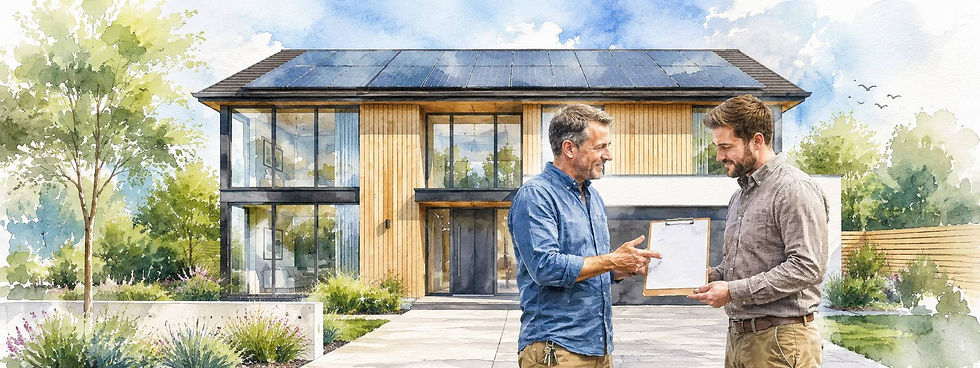
Solar panels for landlords can provide a practical way to improve the energy performance of rental properties while generating renewable electricity for tenants, communal areas or other parts of a property portfolio.
For landlords undertaking refurbishment, roof replacement or wider energy improvements, solar can be particularly worth considering because installation can often be coordinated with other work already taking place.
The opportunity is not limited to individual houses. Solar can potentially be installed on houses in multiple occupation, blocks of flats and larger residential developments, although the way the electricity is distributed and paid for needs to be considered carefully.

Why Should Landlords Consider Solar Panels?
Energy efficiency is becoming increasingly important to both landlords and tenants.
Tenants are naturally interested in the cost of running their homes, while landlords have an interest in maintaining desirable, efficient properties that remain competitive within the rental market.
Solar panels can contribute towards both objectives.
Potential benefits include:
-
improving the property's energy performance
-
reducing electricity purchased from the grid
-
providing lower-cost electricity for tenants
-
making the property more attractive to prospective renters
-
generating electricity for communal areas
-
supporting EV charging
-
combining solar with battery storage
-
improving a property during refurbishment
-
demonstrating investment in energy efficiency.
The exact financial benefit depends upon who uses the electricity generated and how the rental property is arranged.
Solar Panels on Rental Properties
A landlord who owns the entire property is generally in a much stronger position to consider solar than an individual tenant.
For a conventional single-family rental property, the arrangement can be relatively straightforward.
Solar panels are installed on the landlord's building and the electricity generated can be used within the property.
The tenant may therefore benefit from lower electricity consumption from the grid.
This can make the property more attractive without requiring the landlord to change the basic way the tenancy operates.
Do Solar Panels Benefit Tenants?
They certainly can.
Where the solar system is connected directly to the rented dwelling, electricity generated during the day can reduce the amount that the tenant needs to buy from their energy supplier.
The greatest benefit is normally achieved when electricity is used at the same time that the panels are generating.
A tenant working from home, for example, may use solar-generated electricity for:
computers, appliances, washing machines, dishwashers, electric heating, air conditioning and other daytime loads.
This makes the solar installation a tangible benefit rather than simply an environmental feature.
Solar Panels for Renters
People searching for solar panels for renters often face a different situation from homeowners.
A tenant generally cannot simply arrange for a permanent photovoltaic installation to be fixed to somebody else's roof.
The roof forms part of the landlord's property and installing solar normally requires the property owner's agreement.
For tenants who would like solar, the practical route is therefore usually to raise the possibility with their landlord.
From the landlord's perspective, a tenant expressing an interest in renewable energy may indicate that solar could add to the property's appeal.
Solar Panels for Apartment Renters
Solar panels for apartment renters can be more complicated because individual flats may not own or control the roof above them.
The roof may belong to:
a freeholder, management company, residents' management company or another building owner.
Even where the landlord owns an individual flat, they may not have the right to install equipment on the communal roof.
This means that solar for apartment buildings is usually better considered as a whole-building project rather than separately by individual tenants.
Solar Panels for Blocks of Flats
A block of flats can potentially provide substantial roof space for photovoltaic panels.
The question is then how the electricity should be used.
One of the simplest options is to supply electricity to communal areas.
Solar-generated electricity could contribute towards:
-
communal lighting
-
lifts
-
entrance systems
-
security equipment
-
ventilation
-
pumps
-
electric gates
-
management offices
-
shared EV charging.
This can reduce the electricity expenditure associated with operating the building.
In some developments, more sophisticated arrangements may allow solar generation to benefit individual flats, but this requires more detailed electrical and metering design.
Landlords With Multiple Properties
For portfolio landlords, solar becomes particularly interesting because installations can potentially be considered strategically rather than one property at a time.
A portfolio could be reviewed to identify buildings with:
good roof orientation, large available roof areas, strong daytime electricity consumption and long-term rental potential.
Properties can then be prioritised according to which are likely to gain the greatest benefit.
This could allow a landlord to develop a phased programme of solar installations across the portfolio.
Solar Panels for HMOs
Houses in multiple occupation can be particularly interesting candidates for solar.
An HMO may have electricity demand throughout much more of the day than a conventional single-family property.
Several occupants may be using:
lighting, cooking equipment, washing machines, computers and other appliances at different times.
Where the landlord includes electricity within the rent, reducing electricity purchased from the grid may provide a direct financial benefit to the landlord.
The economics therefore differ considerably from a tenancy where the tenant pays their own energy supplier directly.
Landlord-Paid Electricity
Solar can be particularly attractive where the landlord pays some or all of the electricity costs.
This could apply to:
HMOs, serviced accommodation, student housing, communal areas or properties where utilities are incorporated into the rent.
In these circumstances, electricity generated by solar panels can directly reduce one of the landlord's operating costs.
The relationship between solar generation and electricity consumption should therefore be examined carefully when sizing the system.
Tenant-Paid Electricity
Where the tenant pays their own electricity bill, the immediate saving generally passes to the tenant rather than the landlord.
That does not automatically make the investment unattractive.
A landlord may still benefit through:
improved property specification, stronger tenant appeal, lower running costs for occupants and potentially improved energy performance.
The financial case therefore needs to consider the landlord's objectives rather than looking solely at the value of electricity generated.
Solar Panels and Property Refurbishment
One of the best times for a landlord to consider solar is when substantial work is already being undertaken.
If a property is undergoing refurbishment, extension or roof replacement, solar can be incorporated into the wider project.
This can make installation easier because scaffolding may already be present and electrical works may already be taking place.
Cable routes, inverter positions and future battery locations can also be considered before the property is redecorated.
It is generally much easier to plan energy improvements before the refurbishment is complete than to return afterwards and start opening finished walls and ceilings.
Solar Panels During Roof Replacement
If a rental property's roof is approaching the end of its life, it may make sense to coordinate roof replacement with the solar installation.
Solar panels are intended to remain in position for many years.
Installing them immediately before major roof work becomes necessary could result in the panels having to be removed and reinstalled.
A landlord planning roof replacement should therefore consider whether solar should form part of the same improvement programme.
Solar Panels on Flat Roof Rental Properties
Many flats, apartment buildings and converted properties have flat roofs.
These can potentially provide good locations for photovoltaic panels.
Panels are normally mounted on specialist systems that position them at an appropriate angle.
The design needs to consider:
roof condition, drainage, wind loading, parapets, rooflights and maintenance access.
For larger residential buildings, structural capacity should also be considered before substantial equipment is installed.
Solar Panels on Pitched Rental Properties
Traditional houses and converted buildings frequently have tiled or slated pitched roofs.
Solar panels can normally be installed using rails and brackets fixed back to the supporting roof structure.
Panel layout will depend upon:
roof orientation, available space, shading, chimneys, dormers and rooflights.
A carefully planned installation should also take account of the appearance of the building, particularly where the property is in a sensitive location.
Solar Panels for Listed Rental Properties
Listed buildings require additional consideration.
Solar panels are not automatically impossible, but alterations affecting the character or historic fabric of a listed building can require consent.
Alternative roof slopes, outbuildings or less visually prominent positions may sometimes provide a better solution.
The planning and heritage position should therefore be considered before committing to the solar installation.
Solar Panels in Conservation Areas
Rental properties within conservation areas may also require greater design care.
Roof-mounted solar can often still be possible, but the visibility and positioning of the panels may become important.
Panels on a highly prominent front roof slope can raise different issues from an installation on a less visible rear elevation.
Checking the planning position early can prevent unnecessary redesign later.
Solar Panels and EPC Ratings
Landlords increasingly think about energy improvements as part of the overall performance of the property.
Solar photovoltaic panels can form one element of a wider energy-efficiency strategy.
However, solar should not necessarily be considered in isolation.
A property may also benefit from:
improved insulation, better glazing, efficient heating, smart controls and draught reduction.
For landlords refurbishing older properties, combining several measures can provide a much more comprehensive improvement than relying upon a single technology.
Solar Panel Grants for Landlords
There is interest in solar panel grants for landlords, but funding schemes and eligibility criteria can change.
Not every landlord or rental property will qualify for financial support.
Some programmes may be aimed at:
low-income households, particular energy-efficiency improvements, local authority areas or specific types of property.
Other schemes may require the tenant or household to meet eligibility criteria rather than simply the property owner.
Landlords should therefore check the current funding position before making an investment decision.
A solar quotation should ideally make sense on its own merits rather than depending entirely upon receiving a grant that may not ultimately be available.
Solar and Battery Storage for Landlords
Battery storage can allow electricity generated during the day to be retained for use later.
This can be particularly useful in residential properties because household energy consumption often rises during the evening.
For example, a solar array may generate substantial electricity around midday while tenants are away.
Without a battery, much of that surplus could potentially be exported.
A battery can store some of the electricity for use when occupants return home.
Whether this provides good value will depend upon the property, solar-system size and tenant's consumption pattern.
Solar Panels and EV Charging
Electric vehicle charging provides another potential benefit for landlords.
Properties with driveways or dedicated parking can increasingly benefit from EV charging provision.
Combining an EV charger with solar allows some vehicle charging to be supplied from electricity generated on the property.
This can make a rental home particularly attractive to tenants who already own or intend to purchase an electric vehicle.
For landlords developing or substantially refurbishing a property, it can therefore make sense to consider solar and EV charging together.
Solar Panels, EV Charging and Air Conditioning
There is also an opportunity to consider solar as part of a broader package of improvements.
Modern rental homes may increasingly incorporate:
solar PV + battery storage + EV charging + air conditioning or air-to-air heat pumps.
These technologies can complement one another.
During bright summer weather, when solar generation is strong, electricity can contribute towards cooling the home.
Solar electricity can also contribute towards charging an electric vehicle or battery.
Rather than treating each system as an unrelated future alteration, landlords carrying out substantial refurbishment can consider the electrical infrastructure for all of them at the same time.
Solar for Build-to-Rent Developments
Larger build-to-rent schemes can potentially integrate solar from the design stage.
This allows photovoltaic panels to be considered alongside:
roof design, heating strategy, EV charging, communal electricity consumption and building energy management.
Designing everything together can be considerably more efficient than retrofitting separate technologies after the development has been completed.
For larger developments, solar may therefore form part of the building's overall energy strategy from the outset.
Solar Panels for Student Accommodation
Student accommodation can have high levels of electricity consumption.
Occupancy patterns may differ from conventional households because residents use kitchens, computers, lighting and other equipment throughout much of the day.
Large purpose-built student developments can also have substantial communal electricity demand.
Solar panels may therefore contribute towards both individual and communal energy consumption depending upon the electrical arrangement.
Solar Panels for Serviced Accommodation
Serviced apartments and short-term rental properties present another interesting opportunity.
Where the property owner pays the electricity bills, energy savings from solar can pass directly to the business.
Air conditioning can also be significant in higher-specification serviced accommodation.
A solar installation can therefore contribute towards the electricity used for cooling during sunny summer conditions.
Who Owns the Solar Panels?
Landlords should establish clearly who owns the solar installation.
Where the landlord purchases the system outright, ownership is normally straightforward.
Alternative finance arrangements can sometimes involve a third party retaining ownership of the panels.
This can create additional contractual considerations, particularly if the property is later sold or refinanced.
The terms of any finance, lease or electricity-purchase agreement should therefore be understood before proceeding.
What Happens When the Tenant Changes?
A properly installed solar system remains part of the property regardless of changes in tenancy.
New tenants can continue to benefit from the electricity generated.
Landlords should ensure that occupants understand the basic operation of the system, particularly where battery storage or smart controls are installed.
Simple information explaining how to make best use of daytime solar generation can help tenants obtain greater benefit.
Solar Panel Monitoring
Most modern solar systems provide some form of generation monitoring.
This allows performance to be checked over time.
For landlords, remote monitoring can be particularly useful because it reduces the need to rely upon tenants noticing that the system is not operating correctly.
Unexpected reductions in generation can then be investigated.
Maintaining Solar Panels on Rental Properties
Solar photovoltaic systems generally require relatively little routine maintenance.
However, landlords remain responsible for ensuring that equipment associated with their property is appropriately maintained.
Periodic checks may include:
panels, mounting equipment, cabling, inverter operation and monitoring systems.
Where panels are difficult to access, specialist contractors should undertake inspection or cleaning rather than tenants attempting to access roofs.
Solar Panel Warranties
Solar systems can involve several different warranties.
These may cover:
the photovoltaic panels, inverter, battery equipment and installation workmanship.
Landlords should retain copies of warranties and installation documentation as part of the property's records.
This information may also become useful when the property is sold.
How Much Do Solar Panels for Landlords Cost?
The cost depends upon the property and system size.
A modest terraced or semi-detached house may require a relatively small installation.
A large HMO, apartment building or multi-property portfolio could involve a much more substantial project.
Costs can be influenced by:
panel numbers, inverter specification, roof type, scaffolding, electrical work, battery storage and EV charging equipment.
Landlords should therefore compare complete proposals rather than simply looking for the lowest headline panel price.
Is Solar Worth It for a Rental Property?
It depends upon the property and the landlord's objectives.
Solar can be particularly attractive where:
the landlord pays the electricity bill, the property has substantial daytime consumption, the roof is suitable, refurbishment is already planned or the landlord intends to retain the property long term.
For conventional rental houses where tenants pay their own electricity bills, the direct financial benefit to the landlord may be less obvious.
However, solar can still improve the specification and attractiveness of the property.
The Green Rental Property
The longer-term opportunity is to stop thinking of solar as an isolated addition to a rental property.
A modern energy-conscious rental home could combine:
good insulation, efficient heating, solar PV, battery storage, EV charging and efficient cooling.
These elements can work together to create a more comfortable, lower-energy property.
For landlords planning major improvements, extensions or refurbishment, considering these systems together can also avoid duplicated work later.
Planning Solar Panels for a Rental Property?
Whether you own one rental house or a substantial property portfolio, solar panels for landlords should be considered in the context of the building, the tenancy and the way electricity is actually consumed.
Roof condition, available space, electricity arrangements, battery storage, EV charging and future refurbishment plans can all influence the best solution.
For landlords undertaking more extensive property improvements, it can be particularly worthwhile considering solar as part of a wider green property package rather than treating it as a stand-alone installation.
APN Solar can help landlords and property investors connect with experienced solar specialists who can assess the property, recommend an appropriate system and provide quotations for solar PV, battery storage and related energy improvements.